
AI Can Create Content in Seconds — So What Makes a Human Marketer Valuable in 2027?
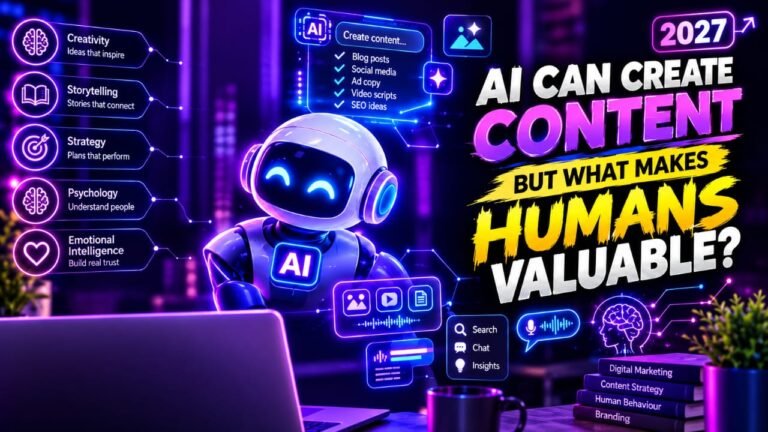
A few years ago, writing a blog post took hours. Today, AI can generate one in under a minute. Ask it for a product description, a social media caption, or even a full content calendar, and it delivers instantly. This shift is real, and it is only getting faster.
So here’s the question every marketer is quietly asking themselves: if AI in digital marketing can do so much, so quickly, what’s left for the humans?
Turns out, quite a lot. But the role is changing, not disappearing.
AI Has Changed the Speed of Marketing, Not the Soul of It
Walk into any marketing team today, from a startup in Bangalore to an agency in London, and you’ll find AI tools woven into daily work. AI content creation tools draft blog outlines. AI marketing platforms predict which ad will perform best. Chatbots handle customer queries at 2 AM. None of this was standard practice five years ago.
In Kerala, small businesses that once couldn’t afford a full marketing team now use AI tools for marketers to write product listings, schedule Instagram posts, and even generate basic ad copy. In the US, large brands run AI-powered A/B tests across thousands of ad variations before a human ever reviews the results. In the UAE, e-commerce companies use AI to translate and localize campaigns across Arabic and English audiences within minutes.
Speed and scale are no longer the differentiators. Everyone has access to the same tools. And that’s exactly why the human touch matters more, not less.
Where AI Genuinely Excels
Let’s be fair to the technology. AI is brilliant at certain things.
- Analyzing large datasets to spot patterns humans would take weeks to find
- Generating first drafts of copy, emails, or product description
- Personalizing content at scale for thousands of users simultaneously
- Automating repetitive tasks like reporting, tagging, and basic SEO audits
- Predicting trends based on historical data
But here’s the catch. AI works from patterns it has already seen. It doesn’t experience culture, emotion, or a market shift the way a human does. It reacts to data. It doesn’t originate meaning.
What AI Still Can't Do (At Least Not Well)
It Doesn't Understand Culture the Way People Do
A joke that lands perfectly in New York might confuse or even offend someone in Riyadh. A festival campaign built around Onam in Kerala needs a completely different emotional tone than a Black Friday push in Chicago. AI can mimic cultural references it has been trained on, but it doesn’t grasp why something resonates. Human marketers who’ve lived inside a culture, who understand its humor, its sensitivities, and its unspoken rules, bring something no model can replicate.
It Lacks Real Emotional Intelligence
Great marketing often works because it makes people feel something. A brand story about a small business surviving hardship, or an ad that captures the quiet pride of a first job, requires genuine emotional insight. AI can imitate the structure of emotional storytelling, but it doesn’t feel the stakes. Human creativity still writes the stories people actually remember.
It Struggles With Original Strategic Thinking
AI can suggest tactics based on what has worked before. But real strategy often means doing something that hasn’t been tried yet, taking a calculated risk based on gut instinct, market feel, and experience. When Nike, Dove, or a regional brand in Dubai launches a campaign that breaks convention, that decision usually comes from a human who understood the moment, not an algorithm predicting the average outcome.
It Can't Make Judgment Calls Under Pressure
When a campaign goes wrong, when a tweet gets misread, when a competitor suddenly changes strategy, someone needs to make a fast, nuanced decision. Critical thinking and quick judgment remain deeply human skills, especially when the “right” answer isn’t in any dataset.
The Marketer's New Job Description
The future of digital marketing isn’t AI versus humans. It’s AI plus humans, working differently than before.
By 2027, the most valuable marketers won’t be the ones who can write the fastest or run the most ads. They’ll be the ones who know how to:
- Direct AI tools effectively, prompting them with clarity and reviewing output critically
- Add cultural and emotional nuance that AI misses
- Build brand strategy that reflects genuine human insight, not just data trends
- Make final creative and ethical decisions AI shouldn’t be trusted to make alone
- Connect the dots between data, culture, and storytelling
Think of AI as a highly capable junior assistant. It can draft, suggest, and analyze. But it still needs a senior mind to decide what’s actually worth publishing.
Real-World Shifts Already Happening
In the UK, several agencies have restructured teams so that strategists and creative directors spend more time on brand voice and less on manual content production. In the US, companies are hiring “AI marketing specialists,” people whose entire job is training and refining AI outputs to match brand tone. In India, digital marketing courses have started adding AI tools training alongside traditional skills like copywriting and SEO, recognizing that both now go hand in hand.
Even in smaller markets like Kerala, local businesses are learning that AI handles the “what” of content, while they still need to nail the “why.” A restaurant can use AI to generate a dozen caption options, but only a human who understands local taste, timing, and community sentiment will pick the one that actually connects.
Digital Marketing Skills That Matter More Than Ever
As AI takes over routine tasks, certain human skills are becoming the real differentiators:
Storytelling that connects emotionally, not just informs
- Storytelling that connects emotionally, not just informs
- Strategic thinking that anticipates where a market is heading
- Cultural fluency across different regions and audiences
- Ethical judgment, especially around data use and AI-generated content
- Adaptability, since tools and trends keep shifting fast
The Future of Marketing Is a Partnership
AI in digital marketing isn’t a threat to human marketers who are willing to evolve. It’s a tool, a powerful one, that removes the grunt work and frees people up to focus on strategy, creativity, and genuine connection.
The marketers who struggle in the coming years won’t be the ones who use AI. They’ll be the ones who rely on it entirely and forget why their audience trusted them in the first place. Machines can produce content in seconds. But meaning, trust, and cultural understanding still take a human mind to build.
Heading into 2027, the brands that win won’t just be the ones using the smartest AI tools. They’ll be the ones pairing that technology with marketers who still know how to think, feel, and understand people the way no algorithm ever will.